 America
Buy a treadmill if you want to train walking or running — the movement you use in the rest of your life — and can accept the impact and the noise. Buy an elliptical if joint impact is the thing you are avoiding: injuries, arthritis, downstairs neighbors, or simply wanting long sessions that leave nothing sore.
Head-to-Head
| Criterion | Treadmill | Elliptical | Edge | See price |
|---|---|---|---|---|
| Joint impact | Full running impact; walking is moderate | Near zero — feet never leave the pedals | Elliptical | |
| Calorie burn at equal effort | Slightly higher at hard running paces | Comparable at matched effort; easier to underwork | Treadmill, narrowly | |
| Carryover to real life | Direct — walking and running are life skills | Indirect — the motion exists only on the machine | Treadmill | |
| Upper body involvement | None beyond arm swing | Moving handles work arms and back lightly | Elliptical | |
| Noise in an apartment | Footfall carries through floors | Nearly silent on magnetic resistance | Elliptical | |
| Space and moving | Heavy; folding decks help | Bulky but lighter; some fold | Draw | |
| Injury and rehab friendliness | Depends on the injury | The default clinical recommendation for impact-free cardio | Elliptical | |
| Training ceiling | Sprints, hills, race prep | Resistance and incline, but no impact stimulus | Treadmill |
Impact and your joints
Every running stride lands with a multiple of your body weight, and a treadmill deck only cushions part of it. That impact is not purely bad — bones and tendons adapt to it, and that adaptation is part of what makes running valuable — but it is exactly what an inflamed knee, a heavy body or a recovering runner does not want. Walking on a treadmill sits in the middle: modest impact, very tolerable for most people.
An elliptical removes impact almost entirely because your feet never leave the pedals. That is why it is the default machine in rehab settings and the usual recommendation for arthritic knees. The cost is specificity: the elliptical motion exists nowhere else in your life, so the fitness transfers but the movement pattern does not.
Calorie burn and training effect
At matched effort the two machines burn calories in the same neighborhood, with hard treadmill running holding a modest edge because moving your body against impact is expensive. The practical difference is behavioral: it is easy to drift on an elliptical, letting momentum do the work at a low heart rate, whereas a treadmill belt forces you to keep pace or step off.
If you train by heart rate or intervals, either machine does the job. If you tend to coast, the treadmill's forced pace is a feature — and if you tend to push through discomfort you should not, the elliptical's forgiveness is the feature instead.
Space, noise and living with one
Treadmills are the heaviest, loudest common cardio machine: motor noise plus footfall, which travels through apartment floors in a way neighbors notice. Folding decks help storage but not weight. Ellipticals on magnetic resistance are close to silent — usually the deciding factor for upstairs apartments — but their fixed footprint is tall and long, and cheap ones can develop clicks that are their own annoyance.
Both machines are bought secondhand constantly, which cuts both ways: depreciation is brutal for new buyers and generous for used ones. Whichever you choose, measure ceiling height too — an elliptical raises you several inches off the floor at the top of the stride.
Who should buy a treadmill
- You want to get better at walking or running specifically — including race training, incline hiking prep, or building the habit of a daily walk
- You respond well to a machine that sets the pace and holds you to it
- You have healthy joints, or you plan to walk rather than run
- Noise is manageable in your space — a garage, a ground floor, a detached house
Our full treadmill guide covers three picks by budget; the representative pick below is a well-reviewed auto-incline folder from that class.
Who should buy an elliptical
- Impact is the problem you are solving: knee or hip arthritis, running injuries, a heavier body, or rehab with a clinician's blessing
- You live above someone and cardio noise is a genuine constraint
- You want long, frequent, low-stress sessions rather than hard intervals
- You like that the moving handles pull your upper body into the work
We have not published a full elliptical roundup yet; the representative pick below is the strongest-reviewed home unit in the class we have verified.
Representative Picks
These two are not a mini-roundup — they are one verified, well-reviewed example of each machine type, so the comparison above connects to something concrete. Our full guides go deeper: see the treadmill guide and walking pad guide for the complete picks.
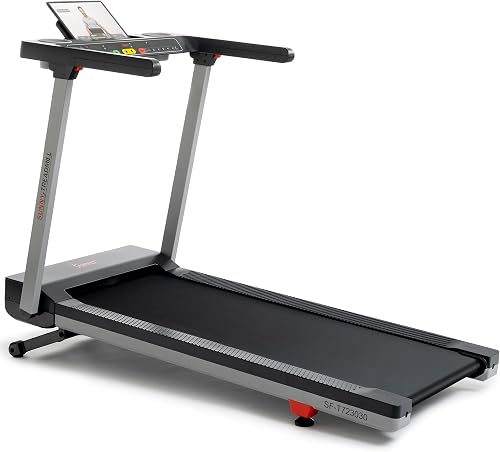
Representative Treadmill: Sunny Health & Fitness Auto Incline Treadmill (Fully Assembled)
Sunny Health & Fitness · 4.4★ from 6,349 verified ratings
- Arrives fully assembled
- Auto incline
- Folding deck with quiet brushless motor
- SunnyFit app and Bluetooth
- 6,300+ verified ratings
A fair stand-in for what a sensible home treadmill looks like in 2026: auto incline, a folding deck, and a brushless motor that keeps walking-speed noise down — from the same brand family as the value pick in our full treadmill guide.

Representative Elliptical: Niceday Elliptical Machine (16 Resistance Levels, Magnetic)
Niceday · 4.4★ from 3,493 verified ratings
- Magnetic drive, near silent
- 16 resistance levels
- 400 lb stated capacity
- Multiple stride options
- 3,400+ verified ratings
The strongest-reviewed true elliptical we verified for this comparison: magnetic resistance quiet enough for an apartment, a high stated capacity, and the stride length that separates real ellipticals from compact steppers.
Your Questions, Answered
Is a treadmill or elliptical better for weight loss?
At matched effort they are close enough that it does not decide the purchase. What decides fat-loss outcomes is total consistent output over months — so the better machine is the one you will actually use four times a week, which is usually the one that matches your joints and your noise constraints.
Which is better for bad knees?
Generally the elliptical, because it removes impact while keeping the legs loaded — it is the standard clinical suggestion for impact-free cardio. But knee pain has many causes, and some conditions tolerate walking better than the elliptical's fixed path. If pain is the reason you are choosing, ask a clinician rather than a comparison article.
Does an elliptical build the same fitness as running?
Cardiovascular fitness, largely yes at equal effort. What it does not build is the impact tolerance and specific mechanics of running — so an elliptical-trained person cannot expect to run far comfortably. If being a runner is the goal, you eventually need the treadmill or the road.
Which takes up more space?
Footprints are similar on paper, but folding treadmills store dramatically smaller, while most ellipticals do not fold and stand tall — and they raise the user several inches, so check ceiling height. In a small apartment, a folding treadmill or a walking pad usually wins on pure space.
Can I just get both?
If space and budget allow, they complement each other well — hard walking or running days on the treadmill, easy volume on the elliptical. Most people are better served buying one machine they will use daily; add the second when the first has earned its floor space for a year.
Related Guides


How We Research
Comparisons are researched and written by Mike Callahan based on the mechanics of each machine type, manufacturer specifications, and patterns across verified owner reviews. We are not a testing lab and do not claim to be; our full standard is in the editorial policy.
Note: This comparison reflects the general mechanics of the two machine types rather than any single product; the two linked models are representative picks, verified live like every product on this site. If joint pain or a medical condition is driving your choice, get individual advice — a category article cannot see your knees.