 America
For most people the NordicTrack T Series is the best home treadmill — a cushioned deck, real incline control and by far the largest owner base of anything at its price. The Sunny Health & Fitness SF-T4400 is the best value, and the 5-in-1 folding treadmill is the best budget pick if space is the constraint.
Our Selection Criteria
We ranked on the specs that predict whether a treadmill survives three years of use: continuous-duty motor rating rather than peak horsepower, belt and deck dimensions, incline range, and stated frame capacity. We favored machines with review histories in the thousands, because treadmill faults tend to surface at 12–18 months rather than on arrival.
1. Best Overall: NordicTrack T Series Treadmill

NordicTrack T Series Treadmill
NordicTrack · 4.3★ from 32,234 verified ratings
- Cushioned running deck
- Smart incline control
- Heart-rate training and guided workouts
- Folds for storage
- More than 32,000 verified ratings
Why we picked it: More than 32,000 ratings is an unusual amount of evidence for a treadmill at this price, and it is the main reason this is the default recommendation. You get a genuinely cushioned deck, powered incline, and a frame built for running rather than brisk walking. The guided-workout content is subscription-based — the machine still works fully without it, and you should not pay the premium expecting otherwise.
2. Best Value: Sunny Health & Fitness Folding Incline Treadmill SF-T4400

Sunny Health & Fitness Folding Incline Treadmill SF-T4400
Sunny Health & Fitness · 4.3★ from 9,221 verified ratings
- Manual incline positions
- Folds with soft-drop hydraulics
- Tablet and device holder
- 9,000+ verified ratings
- Established brand with parts availability
Why we picked it: The SF-T4400 is one of the most widely owned budget-to-mid treadmills in the US, and that matters more than it sounds: parts and belts are easy to source, and the failure modes are well documented. Incline is manual rather than powered, which is the main concession at this price. For walking, jogging and interval work it is more than enough machine.
3. Best Budget: 5-in-1 Foldable Treadmill, 7.5 MPH with 10% Incline
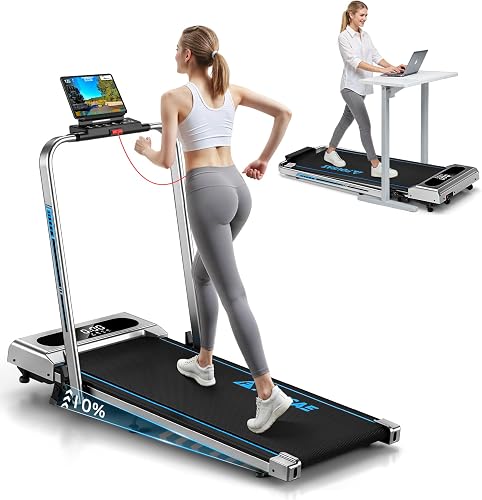
5-in-1 Foldable Treadmill, 7.5 MPH with 10% Incline
Generic · 4.4★ from 651 verified ratings
- 7.5 mph top speed
- 10% incline
- 3.0HP brushless drive
- 400 lb stated capacity
- Folds flat for under-bed storage
Why we picked it: This does things it has no business doing at its price — 7.5 mph, a 10% incline and a brushless motor that runs quieter than brushed units at the same money. The trade-off is deck length and cushioning, so it suits walking and light jogging rather than sustained running. It is the smallest review base in this guide, so treat it as the value gamble it is.
Specs at a Glance
| Pick | Model | Use | Incline | Storage | Best for | See price |
|---|---|---|---|---|---|---|
| Best Overall | NordicTrack | Running | Powered incline | Folding | Runners and mixed households | Check price |
| Best Value | Sunny Health & Fitness | Jogging | Manual incline | Folding | Value without unknown brands | Check price |
| Best Budget | Generic | Walking / light jog | 10% incline | Folds flat | Tight budgets and small rooms | Check price |
What Actually Matters
Continuous-duty horsepower, never peak. Peak HP is a marketing number describing a burst the motor cannot sustain. CHP (continuous-duty horsepower) is what the motor holds indefinitely. For running, 2.5 CHP is a sensible floor; for walking, 2.0 is fine. If a listing only quotes peak, that is itself informative.
Deck length is set by your stride, not your height. Runners generally want 55 inches or more of belt; walkers can live with 45–50. Too short a deck makes you unconsciously shorten your stride, which is both less effective and harder on your knees.
Powered incline is worth more than top speed. Very few home users ever exceed 8 mph, but almost everyone benefits from incline — it raises intensity without raising impact. Powered incline you can change mid-run gets used; manual incline you have to stop and adjust usually does not.
Read the frame and motor warranty separately. Warranties in this category are deliberately split. A headline “lifetime frame” often sits alongside one year on the motor and 90 days on parts and labor. The motor and electronics terms are the ones that will matter to you.
Buyer’s Guide: How to Choose a Home Treadmill
Treadmills are the most-returned cardio machine and the one with the most misleading spec sheets. Use the sequence below and the marketing falls away quickly.
1. Decide whether you will run on it
This single answer sets the budget and the spec. Walking and jogging are gentle on a treadmill; running is not. A machine that will be run on needs a continuous-duty motor rating rather than a peak figure, a belt long enough for a full stride, real deck cushioning and a frame rated well above your weight. A machine that will only be walked on can give up most of that, which is why the value picks on this page are still good buys for the right person. Be honest about which buyer you are today, not who you hope to be.
2. Continuous horsepower, and treat a missing figure as a fact
Peak horsepower describes a burst the motor cannot hold; continuous-duty horsepower (CHP) is what it sustains for an hour. For running, a floor of about 2.5 CHP is sensible; for walking, 2.0 is fine; for heavier runners, higher. A listing that quotes only peak is telling you the continuous number is not worth publishing. Our NordicTrack buyer’s guide shows how one brand’s range maps onto these lines.
3. Belt size follows your stride
Runners generally want 55 inches of belt or more and 20 inches of width; walkers can live with 45 to 50 inches. A short deck makes you shorten your stride without noticing, which is less effective and harder on the knees. Taller runners should go longer still.
4. Powered incline beats top speed
Few home users ever hold 8 mph; almost everyone benefits from incline, which raises intensity without raising impact. Powered incline that changes mid-workout gets used; manual incline that requires stopping and re-pinning the deck mostly does not. Decline is a luxury feature that mainly matters to trail runners.
5. Deck cushioning and frame weight
Cushioning is the treadmill’s reason to exist over pavement. It is also unmeasurable from a listing, so read reviews from runners rather than walkers. Frame weight and stated capacity are the public proxies for stiffness: a heavier machine with a higher capacity flexes less under a running stride and lasts longer at the pivots.
6. Read the warranty in three parts
Treadmill warranties are split into frame, motor, and parts and labor, and headline “lifetime frame” terms often sit alongside a year on the motor and a few months on labor. The motor and electronics terms are the ones that will matter. Also check whether the brand sells belts, decks and control boards as spare parts — a machine you can fix at year three is worth more than one you cannot.
7. Folding, footprint and ceiling
A folding deck adds a hinge and, on hydraulic-assist models, a soft drop that makes it usable daily. The real constraint is height: a treadmill deck lifts you several inches, incline lifts you more, and running adds bounce. Add those to your height and compare against the ceiling before buying — our ceiling-height guide has the numbers by room height.
What We’d Skip
Listings that only quote peak horsepower. The omission is the information. Treat any treadmill whose continuous rating you cannot find as a walking machine, whatever the motor badge says.
Ultra-compact folders for anyone who intends to run. The flat-folding, under-bed treadmills are genuinely useful for walking and light jogging and our budget pick is one of them. They are not running machines: short decks, thin cushioning and low frame weight. Buying one to run on is how the category earns its return rate.
Subscription-locked consoles. Some connected treadmills lose most of their screen functionality without a paid plan. The best implementations, including our top pick, still work fully in manual mode. Check the reviews for what the machine does the day the trial ends.
Any machine whose recent reviews describe belt slipping or a burning smell. Both point to the drive system, both surface at twelve to eighteen months, and a pattern in the latest reviews outweighs a strong overall average built earlier.
Setup, Space and Upkeep
Delivery and assembly. Full-size treadmills are the heaviest thing most people bring into a home gym; the box needs two adults and a clear path through doors and stairs. Assembly is usually the uprights and console onto a pre-built deck, an hour or so with the included tools. Level the feet before the first run — a deck that rocks will walk across the floor and wear the belt unevenly.
Placement. Leave a clear zone of about three feet behind the belt as a safety run-off, keep the safety key clipped to you when running, and put the machine on a rubber mat: it protects the floor, absorbs vibration and keeps dust out of the motor housing. Our flooring guide covers mats that work under treadmills.
Power. Plug directly into a wall outlet on a circuit without other high-draw appliances. Extension cords and power strips are the most common cause of tripped breakers and nuisance error codes.
Belt care. The deck needs lubrication on the interval in the manual, and the belt needs occasional centering and tension adjustment. Neglected lubrication raises motor load and is the most common cause of early motor failure. Our treadmill maintenance guide walks through the lube, centering and tension routines step by step.
Cleaning. Wipe sweat off the console and rails after each run and vacuum around and under the motor housing monthly. Dust in the motor compartment is the slow killer of home treadmills.
Who Should Buy Something Else
You mainly want to walk during the working day. A walking pad slides under a desk, weighs a fraction as much and cannot run — which is fine if you never intended to. Our walking pad vs treadmill comparison settles the choice.
Your knees or hips do not want impact. An elliptical gives a running-like motion with the feet planted, and our treadmill vs elliptical comparison covers who should choose which. For sore joints generally, the low-impact cardio guide lays out every option.
You want the hardest workout per square foot. A stair stepper works the legs harder in less space, and our StairMaster vs treadmill piece compares the two directly.
You are set on one brand. If it is NordicTrack, read our NordicTrack treadmill guide, which explains where each model in the range fits and who should not buy one at all.
Bottom Line: Which Should You Buy?
For most people: the NordicTrack T Series. Cushioned deck, powered incline, enormous owner base.
Best value: the Sunny SF-T4400. Widely owned, easy to get parts for.
On a budget: the 5-in-1 Folding Treadmill. Surprising spec for the money, if space is tight.
Ready to buy?
Jump straight to our picks on Amazon — check the current price at click-through.
Frequently Asked Questions
What are the best treadmills for a home gym in 2026?
Short answer: the NordicTrack T Series Treadmill — 4.3★ from 32,234 ratings. Its case: cushioned running deck. Sunny Health & Fitness is the alternative worth comparing, with 5-in-1 Foldable Treadmill as the best budget. All picks were verified on their live listings; availability and ratings move, so check before you buy.
How much horsepower do I need in a home treadmill?
For walking, around 2.0 continuous-duty horsepower is enough. For regular running, look for 2.5 CHP or more. Ignore peak horsepower figures entirely — they describe a burst the motor cannot sustain and are not comparable between brands.
Are folding treadmills less sturdy?
A folding deck adds a hinge, which is one more thing to develop play over time, but modern folding frames from established brands hold up fine under normal home use. The bigger compromise at any given price is usually deck length rather than the folding mechanism itself.
Is a treadmill or a walking pad better?
They answer different questions. A walking pad adds steps to a sedentary working day and cannot handle running. A treadmill supports actual running training and takes far more floor space. If you want both, a treadmill does the walking job adequately; a walking pad cannot do the running job at all.
How much space does a home treadmill need?
Plan for the machine's footprint plus roughly three feet of clear space behind it as a safety run-off, and check ceiling height — running adds several inches to your standing height, and inclined running adds more.
Do treadmills need servicing?
Belt tension and centering need occasional adjustment, and most decks need periodic lubrication. Neglecting lubrication increases motor load and is the most common cause of early motor failure. Check your manual for the specified interval and lubricant type.
Can I put a treadmill upstairs or in an apartment?
Structurally, a residential floor handles a treadmill and a runner without difficulty. The real issues are noise and vibration transmitted to the room below, which a thick rubber mat reduces but does not eliminate, and getting the box up the stairs. Walkers rarely bother neighbors; runners on a light frame do.
How long do home treadmills last?
Owner reports and warranty structures point to roughly seven to twelve years for a well-built machine that is lubricated on schedule and used as intended, with belts and decks as the consumables along the way. Budget compact folders used for walking often outlast their expectations; the same machines run on hard tend not to.
Should I buy a treadmill with a screen and subscription?
Only if you know you will follow the classes. Guided content is the main reason connected treadmills cost more, and it is a recurring cost after the trial. The hardware is usually good with or without it — make sure the machine runs fully in manual mode, then decide whether the programming is worth paying for.
Related Guides


How We Research
Picks are researched and written by Mike Callahan based on manufacturer specifications, current Amazon listings, and patterns across verified owner reviews — particularly the negative ones. We are not a testing lab and do not claim to be; our full standard is in the editorial policy. Specifications and included accessories vary by listing, so confirm current details at the retailer before buying.
Note: Treadmills are heavy, expensive to return, and their real failure modes surface after a year rather than a week. We deliberately weighted long review histories over new listings with perfect scores. Confirm current motor rating, deck dimensions and warranty terms at the retailer before purchase — manufacturers revise these between production runs without changing the model name. Ratings verified on the live listings September 7, 2026.