 America
The ANCHEER Elliptical is the best all-round machine for most homes — solid stride options and the steadiest owner record in its class. The pooboo is the highest-rated compact pick for tighter spaces and shorter users, and the Niceday long-stride model is the one to buy if you are tall or want the most natural gait of the three.
How We Chose
We screened in-stock home ellipticals against a 4.3-star floor, excluded under-desk and seated 'glider' devices (different product, different job), and excluded one strong machine — the Niceday 15.5–20 inch stride model — because it already serves as the representative elliptical in our treadmill-vs-elliptical comparison. Ranking then followed stride length options, resistance level count and smoothness, frame stability complaints in negative reviews, and footprint. This is a category of modest review bases compared with treadmills; we flag that honestly below.
1. Best Overall: ANCHEER Elliptical Exercise Machine

ANCHEER Elliptical Exercise Machine
ANCHEER · 4.5★ from 1,006 verified ratings
- Smooth magnetic resistance across its full range
- Stable frame with owner reviews citing solid feel underfoot
- Pulse grips and console with the essential metrics
- Compact enough for spare rooms and apartments
Why we picked it: ANCHEER’s machine earns the top slot on balance: a 4.5 average across a four-figure owner base — large for this class — a stable frame that draws few wobble complaints, and resistance that stays smooth at the upper levels where cheaper flywheels turn notchy. Trade-offs: the stride suits small-to-average heights best, and like every machine in this tier the console is basic — think dashboard, not training platform.
2. Best Rated (Compact): pooboo Elliptical Machine, 16-Level
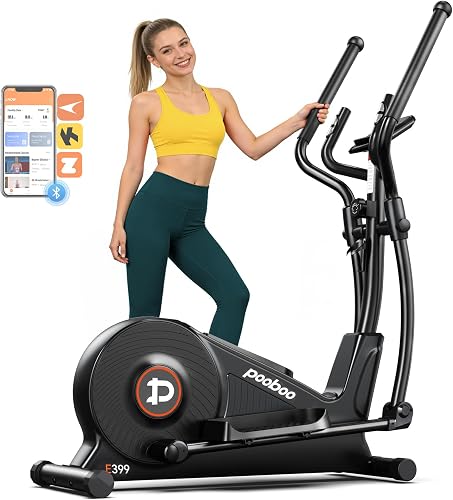
pooboo Elliptical Machine, 16-Level
pooboo · 4.5★ from 490 verified ratings
- 16-level quiet magnetic resistance
- Ties the top rating on this page at 4.5
- Small footprint suited to apartments
- Simple assembly per owner reports
Why we picked it: The pooboo matches the top average here — 4.5 — on the smallest footprint, which makes it the natural pick for apartments and shared rooms where the machine must disappear into a corner. The honest caveats: the review base is a few hundred owners, not a few thousand, and the compact geometry means a shorter stride — taller users will feel it. For users under roughly 5’10” it is an easy recommendation.
3. Best Long Stride: Niceday Elliptical, 15.5/18/19 in Stride
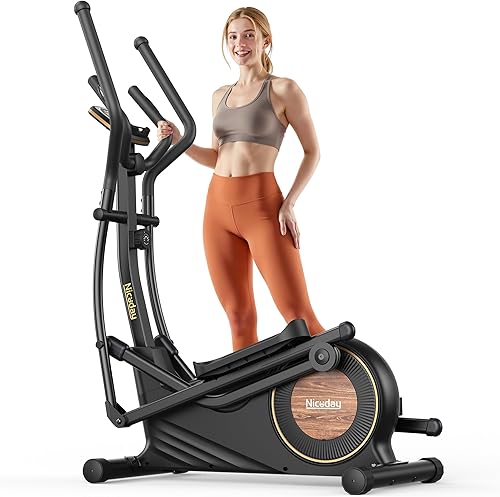
Niceday Elliptical, 15.5/18/19 in Stride
Niceday · 4.4★ from 345 verified ratings
- Adjustable stride up to 19 inches — rare at home-gym size
- Hyper-quiet magnetic drive per owner reports
- Suits taller users who find compact strides cramped
- Sturdy frame with high stated capacity
Why we picked it: Stride is the one spec you cannot upgrade later, and this Niceday’s adjustable 15.5-to-19-inch range is the closest a compact machine gets to the health-club feel. Taller users — the people compact ellipticals shortchange — are exactly who it is for. Trade-offs: the smallest review base of the three, and a slightly larger footprint; measure before buying, and read our ceiling-height guide if it is headed for a basement.
The Full Comparison
| Pick | Brand | Resistance | Best fit | Footprint | Watch-outs | See price |
|---|---|---|---|---|---|---|
| Best Overall | ANCHEER | Magnetic | Average heights | Compact | Largest base in class | Check price |
| Best Rated (Compact) | pooboo | Magnetic, 16 levels | Shorter users | Smallest here | ~490-owner base | Check price |
| Best Long Stride | Niceday | Magnetic | Tall users, 19 in stride | Larger footprint | ~345-owner base | Check price |
Before You Buy
Stride length is the deal-breaker spec. Under about 16 inches feels like stepping for average-height adults; 18 to 20 inches feels like running. Match stride to the tallest regular user, not the average one — a too-short stride is the number-one reason home ellipticals go unused.
Flywheel and resistance quality show up at the top levels. Cheap magnetic systems feel fine at level 4 and notchy at level 14. Reviews that mention “smooth all the way up” — or the opposite — are worth more than any spec-sheet flywheel weight, which brands measure inconsistently anyway.
Stability complaints predict regret. An elliptical rocks more than any other cardio machine when the frame is light, because your weight shifts side to side. Scan negative reviews for “wobble” and “tips”, and favor machines whose owners are heavier users reporting solidity.
Measure height as well as floor. Pedals lift you several inches, and your head bobs through the stride. Add your height, the pedal height, and a few inches of motion to check your ceiling — especially in basements. Our ceiling-height guide has the full arithmetic.
Buyer’s Guide: How to Choose a Home Elliptical
Ellipticals are the cardio machine people most often buy on features and regret on fit. The checklist below is the order we use when we screen candidates, and it is the order the returns and one-star reviews suggest buyers should have used.
1. Stride length, measured against your tallest user
Stride is the distance the pedals travel front to back, and it is the one spec that cannot be changed after purchase. Shorter strides feel like stepping in place; longer strides feel like running. As a working rule, users under about 5’4” are comfortable at 14 to 16 inches, average heights at 16 to 18, and anyone over 5’10” wants 18 to 20. A household with a tall member should buy for that member — a short stride is annoying for a tall user, while a long stride is merely a little loose for a short one. Adjustable-stride machines like our long-stride pick exist precisely to solve mixed households.
2. Drive position: front, rear or center
Where the flywheel sits changes the feel and the footprint. Rear-drive machines produce the flattest, most walking-like path and tend to be longest. Front-drive machines are shorter and tilt the stride slightly, which some users describe as a stair-stepping feel. Center-drive machines are the most compact and put the user between two flywheels. None is objectively better; the point is to read reviews from users who describe the motion, since two machines with identical strides can feel very different.
3. Resistance range and how it feels at the top
Home ellipticals use magnetic resistance, controlled either by a manual knob or a motor on the console. Motorized resistance lets you change levels mid-stride and follow programs; manual is cheaper and never fails electronically. Either way, level counts tell you little. What matters is whether the resistance stays smooth at the top of the range, because cheap flywheels turn notchy exactly where you want them for intervals. Owner reviews that describe the top levels are worth more than any flywheel weight figure.
4. Q-factor and pedal spacing
The distance between the pedals is rarely listed and often complained about. Wide spacing forces your hips outward with every stride and is the usual cause of “my hips hurt after the elliptical”. Compact machines tend to have narrower spacing; heavier full-size machines vary. If a listing gives the pedal spacing, under roughly four inches is comfortable for most adults; if it does not, search the reviews for “hips”.
5. Frame weight and capacity as a stability proxy
An elliptical shifts your weight side to side with every stride, so light frames rock. Stated weight capacity is the closest thing to a public stiffness rating: a higher rating generally means a heavier, wider base, and the reviews of heavier users are the truest test. A machine praised for solidity by people near its capacity limit will feel planted to everyone else.
6. Console honesty
At home-gym prices, treat the console as a dashboard. Time, distance, resistance level and pulse from the grip sensors are useful; calorie figures are estimates that do not know your weight or effort well enough to be precise. Bluetooth and app support are worth having if you will use structured workouts, and worth ignoring otherwise.
What We’d Skip
“Full-size” machines with strides under about 14 inches. Some listings pair a large frame with a short stride and lean on the frame photos. Check the stride figure specifically; if it is missing, that is your answer.
Elliptical-plus-bike hybrids for anyone who wants a real elliptical. The combination units that add a seat compromise the elliptical geometry to fit the bike, and owner reviews consistently rate them as an adequate bike and a poor elliptical. Buy one machine that does one job.
Under-desk and seated “ellipticals” as a substitute for a standing machine. They are a different product with a different purpose — movement during a working day — and we cover them separately in our under-desk elliptical roundup. They will not deliver a standing cardio session.
Any machine whose recent reviews mention the frame cracking or the crank arm failing. These are the two structural failures in the category, they are not repairable at home, and a pattern in the last few months of reviews outweighs a high overall rating built in earlier years.
Setup, Space and Upkeep
Assembly is the biggest job in home cardio. Ellipticals arrive as a flywheel housing plus arms, pedals, rails and a console, and owners commonly report one to two hours with two people for the heavier machines. Lay the parts out by step before starting, torque the crank and arm bolts firmly, and re-check them after the first week and again after a month — loose arm bolts are the origin of most “it started clicking” reviews.
Measure height as well as floor. The pedals sit several inches off the ground at their lowest and your head rises through the stride. Add your height, the pedal height at its peak and a few inches of movement, then compare against the ceiling — low basements are where ellipticals fail to fit. Our ceiling-height guide has the full arithmetic by machine type.
Floor. A rubber mat under the base stops the machine walking across a hard floor during hard efforts and protects the surface from the feet. See our flooring guide for options that work under cardio equipment.
Noise sources. A magnetic elliptical is quiet by design, so any noise is mechanical: a squeak is usually a dry pivot, a click is usually a loose bolt, and a rhythmic knock is usually a pedal arm. All three are five-minute fixes with a wrench and a little silicone lubricant if caught early.
Upkeep. Wipe sweat off the arms and rails after use, lubricate the rail wheels and pivots on the schedule in the manual, and keep the flywheel housing clear of dust. There is no belt to tension and no deck to lubricate — one of the elliptical’s quiet advantages over a treadmill.
Who Should Buy Something Else
You want to train for running. An elliptical builds aerobic fitness but not running-specific strength or impact tolerance. If race times matter, a home treadmill is the honest tool, and our treadmill vs elliptical comparison walks through the decision in detail.
Your ceiling is the problem. Ellipticals are the tallest cardio machines in use. A recumbent or upright exercise bike gives you the same joint-friendly cardio a foot or more lower.
You want the hardest low-impact workout per minute. A stair stepper or climber works the legs harder at the same impact level, and a rowing machine adds the upper body.
You are still deciding what kind of machine to buy. Our cardio machine chooser puts every type side by side by goal, space and joints, and the low-impact cardio guide covers the options for sore knees and hips.
The Verdict: Which One Is Right for You?
Most people: the ANCHEER Elliptical. The steadiest record in its class across the biggest owner base here.
Small spaces and shorter users: the pooboo 16-Level. The best-rated and smallest of the three — know its stride limits.
Taller users: the Niceday Long Stride. The 19-inch stride is the feature nothing else at this size offers.
Ready to buy?
Jump straight to our picks on Amazon — check the current price at click-through.
Common Questions, Answered
What are the best elliptical machines in 2026?
We rank the ANCHEER Elliptical first — smooth magnetic resistance across its full range — followed by pooboo Elliptical Machine and Niceday Elliptical. Those three cover the range most buyers actually choose between. Ratings quoted on this page were captured from the live Amazon listings on the date shown above.
What stride length do I need on an elliptical?
As a rule of thumb: under 5’4”, 14–16 inches works; 5’4” to 5’10”, aim for 16–18; over 5’10”, treat 18–20 inches as the comfortable range. Adjustable-stride machines like our long-stride pick cover mixed households best.
Are home ellipticals really quiet enough for apartments?
Magnetic-drive ellipticals are among the quietest cardio machines made — the dominant sounds are footfall and belt hum, and downstairs neighbors generally notice nothing. A rubber equipment mat removes most of what remains.
Why do elliptical review counts look small compared to treadmills?
The home elliptical market is more fragmented across near-identical models, so individual listings accumulate reviews slowly. We flag base sizes on every pick for exactly that reason — a 4.5 across a thousand owners means more than a 4.8 across forty.
Elliptical or treadmill for weight loss?
The machine you will actually use four times a week beats the theoretically superior one. Calorie burn at equal effort is broadly similar; the elliptical’s advantage is that zero impact makes those sessions easier to repeat. Our treadmill-vs-elliptical comparison walks the whole decision.
How long does it take to assemble a home elliptical?
Plan for one to two hours and, for the heavier full-size machines, a second person for the step where the arms and pedal rails attach. Owner reports put compact models closer to an hour solo. Torque the crank and arm bolts firmly and re-check them after the first week.
Is an elliptical good for bad knees?
For many people, yes — the feet never leave the pedals, so there is no impact, and the motion keeps the knee within a moderate range. The exceptions are users who find a particular stride length or pedal spacing aggravating, which is why fit matters more than brand here. Anyone with a diagnosed knee condition should ask a clinician; nothing here is medical advice.
Should I pedal backward on an elliptical?
Reverse pedaling shifts emphasis toward the glutes and hamstrings and breaks up a long session, and every machine on this page supports it. Keep the resistance moderate going backward — the motion is less familiar and balance suffers at high effort.
Related Guides


How We Research
Picks are researched and written by Mike Callahan based on manufacturer specifications, current Amazon listings, and patterns across verified owner reviews — particularly the negative ones. We are not a testing lab and do not claim to be; our full standard is in the editorial policy. Specifications and included accessories vary by listing, so confirm current details at the retailer before buying.
Note: Home ellipticals carry smaller review bases than treadmills or bikes, and we have flagged each pick’s base size rather than hiding it. Ratings verified on the live listings September 7, 2026; stride and capacity figures are manufacturer-stated — confirm at the listing.