 America
The ZELUS vest — 17,000 owners strong — is the fixed-weight pick for walking and workouts. The RUNmax adjustable scales from 20 lb all the way up for heavy rucking, and the Zeerun is the newer fixed-weight alternative with the widest size run of denominations.
Our Selection Criteria
This category is dense with duplicate listings of the same vest; we mapped families by matching review counts — a heuristic that has caught same-product listings across this site — and picked one representative per family. The 4.3-star floor eliminated little here (vests rate high); differentiation came from bounce and fit complaints in negative reviews, weight-increment options, stitching and buckle failure reports, and reflective features for road walkers.
1. Best Overall (Fixed): ZELUS Weighted Vest, 6–30 lb
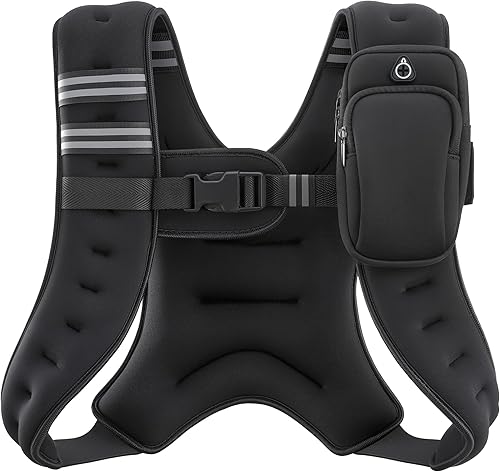
ZELUS Weighted Vest, 6–30 lb
ZELUS · 4.6★ from 17,069 verified ratings
- Denominations from 6 to 30 lb — buy your target weight
- Close fit with minimal bounce for walking and workouts
- Reflective trim for road and dawn walkers
- 17,000-owner base at 4.6
Why we picked it: For the dominant use case — walking, incline treadmill work, bodyweight circuits — a fixed vest’s closer fit beats an adjustable’s bulk, and ZELUS’s is the most-proven listing in the class. Owners consistently cite low bounce at brisk pace, and the reflective trim is a genuine safety feature for road miles. Trade-offs: fixed means fixed — progression requires another vest — and like most fixed vests it is one-size-adjusts, so very small or large frames should read the fit threads first.
2. Best Adjustable / Rucking: RUNmax Adjustable Weighted Vest, 20 lb+

RUNmax Adjustable Weighted Vest, 20 lb+
RUNmax · 4.6★ from 2,169 verified ratings
- Removable weight increments scale far beyond fixed vests
- Optional shoulder pads for heavy carries
- One vest covers beginner to serious rucking loads
- Long-running design with a stable owner record
Why we picked it: When the goal is progressive loading — rucking, stair intervals, weighted calisthenics that climb month over month — buying weight capacity once beats replacing fixed vests. The RUNmax’s removable increments and shoulder-pad option have made it the standing recommendation in rucking communities for years. Trade-offs: it is bulkier and bounces more than a fixed vest at running paces, and at the heaviest loads the vest is only as comfortable as your traps — pads strongly advised.
3. Best Fit Range: Zeerun Weighted Vest, 6–30 lb

Zeerun Weighted Vest, 6–30 lb
Zeerun · 4.6★ from 3,462 verified ratings
- Nine denomination options across the useful range
- Contoured cut owners describe as workout-friendly
- Matches the ZELUS’s 4.6 average on a newer listing
- Adjustable straps accommodate varied frames
Why we picked it: The Zeerun is the modern challenger to the ZELUS: same rating, a denomination run with more steps in the useful 6-to-30 lb range, and a contoured cut that reviewers with smaller frames single out — the group standard fixed vests fit worst. Trade-offs: a base of three-and-a-half thousand is a fraction of the ZELUS’s (still substantial), and as with all fixed vests, buying your third denomination costs more than one adjustable would have.
Specs at a Glance
| Pick | Brand | Weight system | Best for | Fit notes | Owner base | See price |
|---|---|---|---|---|---|---|
| Best Overall (Fixed) | ZELUS | Fixed, 6–30 lb | Walking, circuits | Low bounce, reflective | 17k owners | Check price |
| Best Adjustable / Rucking | RUNmax | Adjustable increments | Rucking, progression | Bulkier, pad option | 2.1k owners | Check price |
| Best Fit Range | Zeerun | Fixed, 9 options | Varied frames, workouts | Contoured fit | 3.4k owners | Check price |
What Actually Matters
Fixed versus adjustable is the first fork. Fixed vests fit closer and bounce less — better for walking, running and circuits. Adjustables scale — better for rucking and progressive loading. Pick the use case first; the “wrong” type is the one that ends up in a closet.
Start lighter than pride suggests. A common starting range is 5 to 10 percent of body weight for walking, progressing gradually. Jumping straight to heavy loads is how shoulders, hips, and enthusiasm get hurt — and anyone with joint or back conditions should clear vest work with a professional first.
Bounce ruins vests at speed. Read reviews specifically from runners and fast walkers: a vest that is fine at strolling pace can hammer your shoulders at a jog. Close fit, chest cinch, and evenly distributed weight are what tame it.
Check the failure points. Vest complaints cluster at buckle plastic, strap stitching, and — on sand-filled models — seam leaks. Owner photos in critical reviews reveal more than any product shot; look before buying, whatever brand you choose.
Bottom Line: Which Should You Buy?
Daily walks and workout circuits: the ZELUS fixed vest. The class’s proven default — buy the denomination you will actually wear.
Rucking and progressive loading: the RUNmax adjustable. Weight capacity bought once, with room to grow for years.
Smaller or harder-to-fit frames: the Zeerun fixed vest. The contoured alternative with the most denomination steps.
Ready to buy?
Jump straight to our picks on Amazon — check the current price at click-through.
Frequently Asked Questions
What are the best weighted vests in 2026?
Short answer: the ZELUS Weighted Vest — 4.6★ from 17,069 ratings. Its case: denominations from 6 to 30 lb — buy your target weight. RUNmax Adjustable Weighted is the alternative worth comparing, with Zeerun Weighted Vest as the best fit range. All picks were verified on their live listings; availability and ratings move, so check before you buy.
How heavy should a weighted vest be for walking?
Common practice starts around 5 to 10 percent of body weight, held for several weeks before progressing. Heavier is not better early — joint loading climbs faster than the cardio benefit does. Health conditions make this a professional’s question, not ours.
Can I run in a weighted vest?
Fixed, close-fitting vests at modest weights tolerate easy running; bulky adjustables at heavy loads mostly do not — bounce loads your spine and shoulders with every stride. If running is the goal, prioritize the lowest-profile vest that fits snugly, and build up very gradually.
Do weighted vests build muscle?
They make bodyweight movements harder — push-ups, pull-ups, dips, squats — which drives progression the same way added plates do. For walking, the effect is more calorie burn and bone-loading stimulus than visible muscle; useful, but different.
What is the difference between a weighted vest and a ruck plate carrier?
Carriers hold a single flat plate high on the back — the rucking standard — while vests distribute smaller weights around the torso. Vests suit mixed training; carriers suit long walks under load. The RUNmax-style adjustable splits the difference for most people.
Related Guides


How We Research
Picks are researched and written by Mike Callahan based on manufacturer specifications, current Amazon listings, and patterns across verified owner reviews — particularly the negative ones. We are not a testing lab and do not claim to be; our full standard is in the editorial policy. Specifications and included accessories vary by listing, so confirm current details at the retailer before buying.
Note: Duplicate listings are endemic in this category; we matched review counts across listings to avoid featuring the same vest twice, and verified ratings on the live listings August 5, 2026. Weight-increment availability varies by size variant — check your denomination.